
How Burke County Court Records Search Works
The main online source for Burke County court records is the North Carolina eCourts Portal. Burke County does not have a separate county-run case database for Superior Court or District Court case files. The statewide Portal is used for public case information, hearing searches, judgment index searches, and eligible court payments. When the Portal does not show the needed record, the fallback is the Clerk of Superior Court at the Burke County Courthouse.
The North Carolina court records access guidance separates online public data from courthouse files. Public terminals in clerk offices can be used for criminal cases by defendant name, case number, victim, or witness. Civil actions, special proceedings, and estate records can also be researched through courthouse terminals and paper files in the county where the case is located.
- Open the eCourts Portal and choose Smart Search for a case summary or register of actions.
- Search by case number or party name. Use the wildcard rules when only part of a name or number is known.
- Use Advanced Filtering Options to narrow the search to Burke County, case type, status, filing date range, or party details.
- Use Search Hearings when the goal is a court date, courtroom, hearing time, judicial officer, or attorney-linked calendar entry.
- Use NC Judgment Search for judgment index entries, then return to Smart Search for the fuller case summary.
- Contact the Clerk of Superior Court when a certified copy, paper file, divorce judgment, estate file, or older record is needed.
Burke County Court Records Sources
The North Carolina court records help topic is the broad state source for case access rules and public lookup paths.
That source helps frame the difference between online summaries and official court files kept by the clerk.
The official obtaining court records page explains when to use Portal, public terminals, paper files, copies, certificates, and transcripts.
For Burke County users, the key point is that the online lookup is only one access channel.
Burke County Court Records Search Fields
The eCourts Portal has several search paths. Smart Search is best for a case summary. Search Hearings is best for court dates. NC Judgment Search is best for judgment index entries. The Portal training and resources page documents the main fields, wildcard rules, and the distinction between public access and elevated access.
| Field Label | Type | Required | Notes / Format |
|---|---|---|---|
| Smart Search query | Text | Unspecified | Search by case number or party name. |
| Location | Filter | No | Select Burke County or the courthouse location when the filter is available. |
| Party last name | Text | No | Use at least three characters plus an asterisk for wildcard searching. |
| Party first name | Text | No | Use at least one character plus an asterisk for wildcard searching. |
| Business name | Text | No | Use at least four characters plus an asterisk for a business or nickname. |
| DOB | Date | No | Helps narrow party matches when the field is available. |
| Case type | Filter | No | Civil Actions, Special Proceedings, Estates, and Criminal Actions are documented categories. |
| Filing date range | Date range | No | Narrows the search by when the case entered court. |
| Search Hearings | Text/filter | No | Search by case number, party, attorney, judicial officer, or courtroom. |
| NC Judgment Search | Text/filter | No | Search by party name, case number, case type, status, location, or judgment date. |
The Portal training source also notes that restricted case types and non-public documents require elevated access based on verified need and legal authority.
This is why a public user may see a docket entry but not the document linked to that event.
Types of Burke County Court Records
Burke County court records come from the North Carolina General Court of Justice. Superior Court handles felony criminal cases, civil cases involving more than $25,000, and appeals from District Court. District Court handles misdemeanors, infractions, traffic matters, juvenile matters, domestic cases, small claims appeals, and civil cases below the Superior Court threshold. The Clerk of Superior Court keeps the central court record and also handles probate functions as ex officio judge of probate.
- Criminal court records: charges, warrants or criminal process, bonds, pleas, motions, dispositions, judgments, sentences, probation, costs, and appeals.
- Civil court records: complaints, summonses, answers, motions, orders, judgments, executions, liens, and satisfaction entries.
- Traffic court records: citations, charge codes, court dates, waiver or plea results, fines, costs, and dispositions.
- Family and domestic records: divorce, custody, child support, equitable distribution, alimony, and protective order case material, with limits for safety or minors.
- Estate and special proceeding records: wills, estate applications, inventories, accountings, guardianships, partitions, and clerk orders.
Real property records, birth certificates, death certificates, and marriage certificates are not court case records in Burke County. Those records are handled by the Burke County Register of Deeds. Divorce judgments and estate files route to the Clerk of Superior Court.
What Burke County Court Records Show
A Burke County court record is not just one document. In Portal it may appear as a case summary or register of actions. In the clerk's office it may include pleadings, orders, judgments, file-stamped documents, and paper items that are not available online. The available fields depend on the case type and public-access level.
| Field | What It Shows |
|---|---|
| Case number | The eCourts identifier, often with year, case type letters, sequence number, and county identifier. |
| Case information | Case type, filing date, status, and court location. |
| Party information | Plaintiff, defendant, State, petitioner, respondent, estate, guardian, ward, or other role. |
| Docket or register of actions | A timeline of filings, hearings, orders, continuances, judgments, and other events. |
| Hearings | Court date, courtroom, judicial officer, time, location, and hearing type where public. |
| Dispositions | The outcome of a case or charge, such as dismissed, judgment entered, guilty, not guilty, or closed. |
| Financial information | Costs, fines, restitution, attorney fees, balances, civil judgments, liens, or payment activity when applicable. |
| Documents | Public documents may be viewable, while restricted, sealed, or non-public documents are withheld. |
Burke County Court Records Access Rules
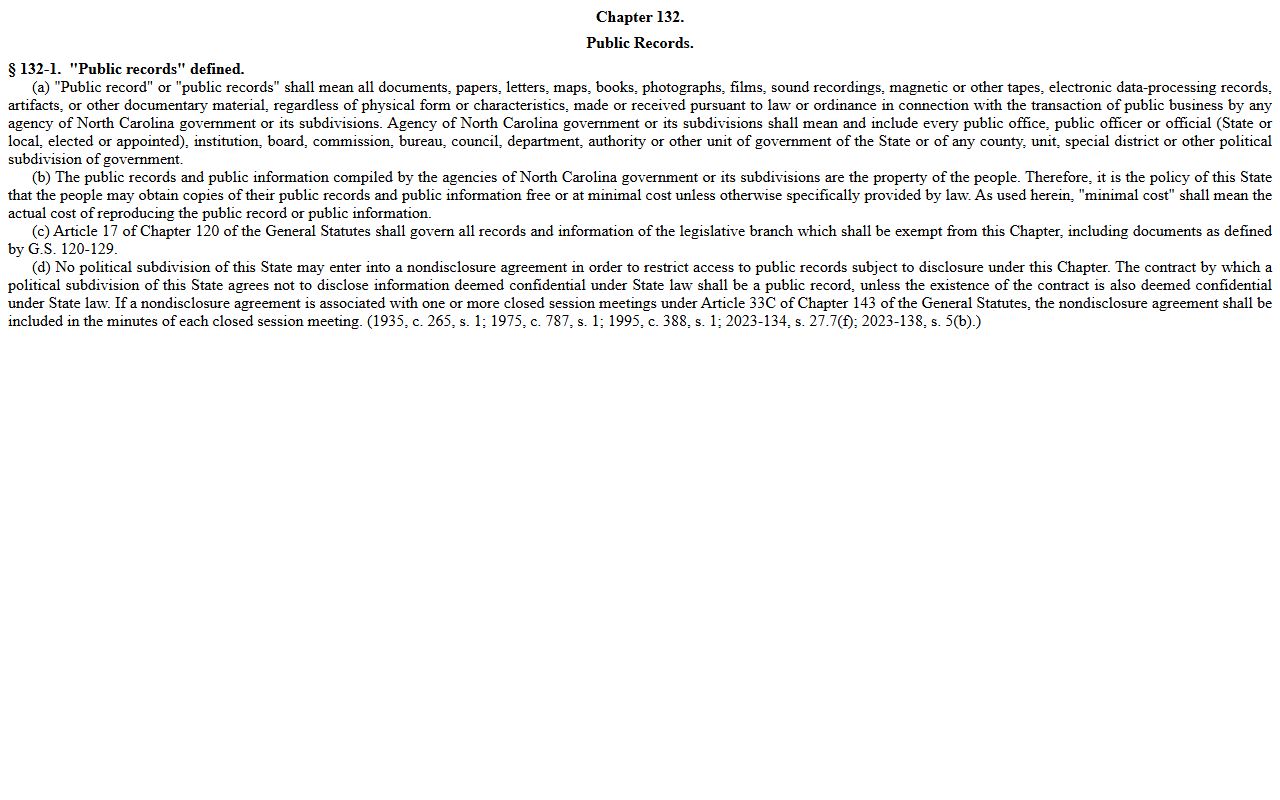
Public access to Burke County court records comes mainly from court-record rules, not the county's general public-records office. N.C.G.S. 7A-109 says clerks maintain court records, dockets, files, and indexes and, except where law prohibits it, those records are open to public inspection during regular office hours. N.C.G.S. 132-1 defines public records broadly for North Carolina agencies, but court files have their own limits.
Police reports and investigative files are different. N.C.G.S. 132-1.4 treats criminal investigation and intelligence records as outside ordinary public-record access. That means an arrest event may have a public court case while the law-enforcement report remains limited or must be requested from the investigating agency.
The criminal background check guidance explains a separate courthouse terminal process for name-based criminal record checks.
Those checks are useful for courthouse research, but certified searches and consumer-reporting uses have separate rules.
Note: Certified court copies should be requested from the Clerk of Superior Court, not downloaded from a third-party site.
Restricted Burke County Court Records
Not every Burke County court record is public. Juvenile delinquency, undisciplined, abuse, neglect, dependency, and juvenile court counselor records are restricted by statute. Mental health, incompetency, guardianship, adoption, protected addresses, Social Security numbers, financial account numbers, medical details, and sealed document attachments may be withheld, redacted, or available only by court order.
Expunged criminal records are also removed from public view when an order is granted under Chapter 15A. Dismissed charges and not-guilty outcomes may use N.C.G.S. 15A-146. Certain nonviolent misdemeanor or felony convictions may use N.C.G.S. 15A-145.5. The effect of an expunction is described in N.C.G.S. 15A-153.
The state public records definition is useful background for Burke County court records, but it does not override court-specific confidentiality rules.
For a sealed, juvenile, or expunged matter, the clerk can explain the filing path, but access usually depends on statute or a judge's order.
Burke County Court Records In Person
In-person record work goes through the Burke County Courthouse in Morganton. The courthouse is the local NC Judicial Branch location for Superior Court, District Court, the Clerk of Superior Court, District Attorney activity, magistrate contacts, family court, public terminals, court payments, certified copies, divorce judgments, estate files, and paper case files. Public users should bring names, case numbers, approximate filing dates, and a clear description of the record needed.
Clerk of Superior Court
Burke County Courthouse
201 South Green St
Morganton, NC 28655
(828) 433-3200
Monday-Friday, 8:30 AM-5:00 PM